

Problem Gambling Ontario: The Health Outcomes Aren’t Random
In my psychotherapy practice, I’ve seen an increase in young men struggling with problem gambling behaviour in recent months. It seems that my experience isn’t unique – ER visits for problem gambling as well as calls to ConnexOntario for gambling addiction have seen massive increases in recent years, with the most glaring increases among young males aged 15-24. A recent CBC News article highlighted the alarming rise in problem gambling and gambling-related suicides in Ontario.
The Impact of Government Policy
These phenomena are not happening randomly – they are the direct result of specific policy decisions implemented at both the provincial and federal levels of government:
- In 2019, Doug Ford’s Progressive Conservative government announced intentions to break up the Ontario Lottery and Gaming Corporation’s (OLG) monopoly on internet gambling, along with defunding Ontario’s independent gambling research body (Gambling Research Exchange Ontario/GREO).
- In July 2021, the province established iGaming Ontario to oversee the implementation of an anticipated private gambling marketplace. In August 2021, due in part to successful lobbying efforts by gaming companies and the government of Ontario, the federal government passed Bill C-218, amending the Canadian Criminal Code to legalize single-event sports betting.
- In April 2022, Ontario became the first province in Canada to launch a government-regulated private online gambling marketplace. In 2024, the provincial government appealed to the courts to allow citizens of Ontario to gamble against other players internationally. In November 2025, the Ontario Court of Appeal ruled in favour of the government’s request, greatly expanding access (and exposure) for Ontarians to international gambling opportunities.
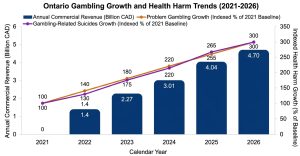
The results of all these policy decisions have thus far had the intended short-term economic consequences. Ontario’s regulated iGaming revenues grew by over 200% from 2022 to 2026. The market expanded from an initial $1.4 billion in gross gaming revenue in 2022 to an annualized trajectory of $4.7 billion by the end of 2026, more than tripling its total size in four years.
As the recent public health data shows, revenues aren’t all that have been growing. Over the same period of time, problem-gambling behaviour and gambling-related suicides in Ontario have been rapidly increasing (highly correlated with revenue growth in the private gambling sector).
Social Determinants of Health
The problem gambling situation in Ontario is an exemplary case of how social determinants of health directly impact people’s well-being. Government policies enacted through legislation have allowed the international private internet gambling industry to penetrate Ontario’s digital marketplace, flooding the feeds of often young and impressionable boys and men with targeted advertisements. The government empowered multibillion dollar gambling and gaming corporations to exploit vulnerable citizens of Ontario, sometimes causing great harm to their health and well-being.
CBC News also reported that federal MPs are now trying to pass legislation to restrict gambling ads in Canada, identifying them as one of the sources contributing to the rising rates of problem gambling (and gambling-related suicide). Two provinces are opposing the bill: Ontario and Alberta.
The Psychological Appeal of Gambling
In the context of living through a time of increasing economic uncertainty, global unrest, and rapid technological changes, it’s no wonder that many people are feeling elevated levels of anxiety. An escape from daily stresses, the thrill of excitement, entertainment, and the promise of wealth are several appealing factors combined in gambling advertisements. Young people in particular are susceptible to introductory giveaways through targeted advertisements that give them a taste of the thrill of winning (and yes, they can and do find ways to bypass legal age restrictions).
Like a drug dealer offering a “free sample” to potential customers, gaming companies offer initial free plays to potential future gamblers.
For those vulnerable to addiction, once the reward potential has been sufficiently triggered, the conditions for compulsive gambling to take hold are present. Many will go on to gamble despite mounting losses and indebtedness, often placing bigger and bigger bets in the hope of regaining money that was lost. This can quickly snowball into massive capital loss and debt, and with it depression, despair, and even suicide.
Help Is Available
Despite the destruction and despair that problem gambling can cause, there is help available to those who want it. There are specialized services available to those who want to get help with problem gambling, some of which are offered (somewhat ironically) through the government of Ontario (the enablers also offer help for the consequences of their enabling): https://igamingontario.ca/en/player/find-help
There are also various apps and options within gaming and gambling services through which players can “self-ban” from participating.
For some people, problem gambling is a symptom of, or occurs alongside, other psychological struggles. In such cases, talking to a skilled psychotherapist can also be beneficial.